

My Hellion Bullpup
Drive By Reviews
Demi Lovato Holy Fvck or Thunder Entered Her. Lovato's album isn't explicitly anti-religious (The closest she comes is "Happy Ending" where she confesses to not feeling comfortable in whatever room god inhabits). Rather, the album is blasphemous because, in an inversion of the poetry of some mystics, she uses religious language to describe the pleasures of sex, specifically fucking in the eponymous track, as well as masturbation in "Heaven." (1/28/23)
It Follows Dir. David Robert Mitchell 2015. Žižek likes some pretty crappy slow moving flics. (2/6/23)
Les Papillons noirs Dir. Merle & Abbou. Pretty good mini series that escapes both the pretentious amateurish muck of post nouvelle vague French cinema as well as the usual Netflix formulaic cliffhangers. But, alas, the laugh out loud surprise ending. (2/15/23)
Blonde Dir. Andrew Dominik. I never really had the hots for Marilyn Monroe. Her looks were the kind which appealed mostly to women and, like Maria Callas, to gays. You can sense this in Niagara where the the girl next door Jean Peters radiated the sensuality and aroused the sexual tension missing in the floozy character played by Monroe. That said, Blonde is a superb film already worthy to be called a classic. It marvelously renders the psychological subtleties of Oates' novel. In addition, the forthright semi-nudity catapults the image of Monroe into the realm of the more modern sexuality projected by her heiresses apparent, Ana de Armas, who is cuter than Monroe, Emily Rajtakowski and Jenna Jameson. (3/12/23)
Isabel del Torre, Fit Kitty, Putri Cinta. These are three of the most attractive and artistically accomplished porn artists working today. I wish Isabel and Kitty would change their makeup. Kitty in particular looks much better with light colors and transparent foundation. Also it's a shame that the two began their artistic careers as late as they did. Their spectacular bodies as they are now would have been even more stunning when they were in their twenties. A good example is Putri Cinta, who began performing with Hegre and Playboy when she was in her early twenties and she radiated the freshness of youth. (3/17/23)
Kreator, Enemy of God. Superlative instrumentals, vocals not so great. It's odd that such disciplined and structured music should be the image and representation of a chaotic and hopeless world. (3/24/23)
Miyoko Ito. Duck:Rabbit :: Abstract Shape:Household Object. (4/15/23)
Japanese Tales of the Macabre, Junji Ito, dir. Shinobu Tagashira. Studio Deen for Netflix. The cheeky Intro featuring a grinning vagina dentata is drenched in glorious saturated colors and semi-automatic fast cuts. Unfortunately it has little to do with the actual episodes which are kinda bleuh. (4/22/23)
Melena Maria, Caught Her by the Tail. One of the great aesthetic experiences of the last few years is the lovely Melena Maria - inexplicably billed as "Malena a" by x-art.com - in her newly favored ghostly whiteness and sporting a white foxtail butt plug. She sinks a few billiard balls for real and not after an obvious cutaway while clearly in the throes of anal ecstasy. (4/22/23)
Richard Dawkins, Piers Morgan https://www.youtube.com/watch?v=505UazMNgLg I hadn't fully appreciated until this interview how great a dunce Piers Morgan really can be. The good Piers began by assuming the role of an aw shucks kinda yobbo and affirming there must be a god because the universe had a beginning and there couldn't just be nothing before the beginning. Dawkins protested a couple of times that he wasn't a physicist but Piers soldiered on repeatedly cutting off the biologist just when his answers were getting interesting. Dawkins trotted out his complexity argument which is not the strongest he might have chosen. Indeed one could question whether the complexity assumption doesn't run afoul of the Second Law of Thermodynamics somewhere. It depends on how you define complexity. But Dawkins isn't a physicist. Dawkins' resigned expression was that of someone who would have preferred to be anywhere else with flashbacks of being cornered during a five hour flight by teams of bushy tailed Xtian creationists. Ah, the price of fame! Meantime Piers started dithering on about Mr. Spock to which Dawkins could easily have responded that, if Piers really chose to be illogical, no one would understand what he was saying or doing, that arguments for the existence of some god or other rely just as much on logical reasoning as does the turn to observation and what the observational facts imply, that the attack on logic is the last redoubt of the defeated disputant, the credo quia absurdum which would be laughed out of any court worth the name. Rather, Dawkins insisted he really loves music and literature, a response, given the record of his critical evaluations of much literary work, had best be passed over in silence. It is not often observed that Mr. Spock is actually a much more interesting and multifaceted character than his down home and benighted critic, Dr. McCoy. To be fair there was a terrific passage in this interview when Dawkins and Morgan connected on the subject of the gender fluidity hoax. Dawkins made an important point to which Morgan agreed. Namely so-called race and sex (or gender or whatever) are not equivalent. Race is the complex expression of several groups of genes working in concert. Consequently one might almost say that each individual is his own race. Morgan interjected that he had been surprised to learn that he had no English DNA but, in addition to Scots and Irish, he had a measure of Middle Eastern DNA. Human sex, on the other hand, is the result of just two genomic configurations. Everyone has one of the two and nothing in between. No combinations or intermediate configurations exist. One consequence is that, while both sexism and racism are deplorable, racism conflicts with scientific biological fact while the binary sexual difference does not, to which I might add there seems to be a built in phenotypic expression of mixed attraction and hostility which characterizes the two genders It is impossible to eliminate the erotic element from the relations between the sexes and choose to treat women as no more than male colleagues in pants suits. (5/1/23)
KMFDM, Blitz "Bait & Switch" Deeply felt and emotionally profound misotheism. (5/6/23)
Jules Olitski. I guess you could call Jules Olitski Jackson Pollock's Dan Quayle. Well, in that case Flat as a Pancake Greenberg is Spiro Agnew. (5/17/23)
The Bow Dir. Kim ki-Duk. The éminence grise behind Kim is largely Bresson and the idea of redemption through suffering. Yet The Bow paradoxically hearkens to Molière with (Finally!) some sympathy for Arnolphe. Bresson's formal and narrative quirks remain abundantly evident although love has replaced pain as the source of blessedness. (5/31/23)
Natalie Vegas. There is a Roman quality to her physique. (6/4/23)
AI dir. Steven Spielberg. AI reveals, almost certainly unwittingly, a moment in the development of the Oedipus Complex which Freud never considered (unsurprisingly since he mainly dealt with the early stages of the construction of the complex) and which he may indeed have rejected. This is the transitional stage to genital sexuality wherein the mother rejects the male child's love. It's an important moment both from an ontogenetic point of view, since it prepares the way for the child to open up to other sexual objects, as well as from the obvious standpoint of evolutionary success. The film also captures the tragic disturbance in the child's perception of time where the never ending story of Oedipal love gives way to the arbitrariness of change, age and death. (6/4/23)
Splendor in the Grass dir Elia Kazan. Like many of his contemporaries Kazan lingers too long on reaction shots leaving the audience to expect something exciting is about the break out and the actor wondering, "What do I do now?" (6/4/23)
Edgar Allan Poe "Berenice." This creepy tale, in which a loving but fever-brained narrator extracts all the teeth fro m the conscious flesh of his prematurely buried sister, is missing from too many anthologies. (6/4/23)
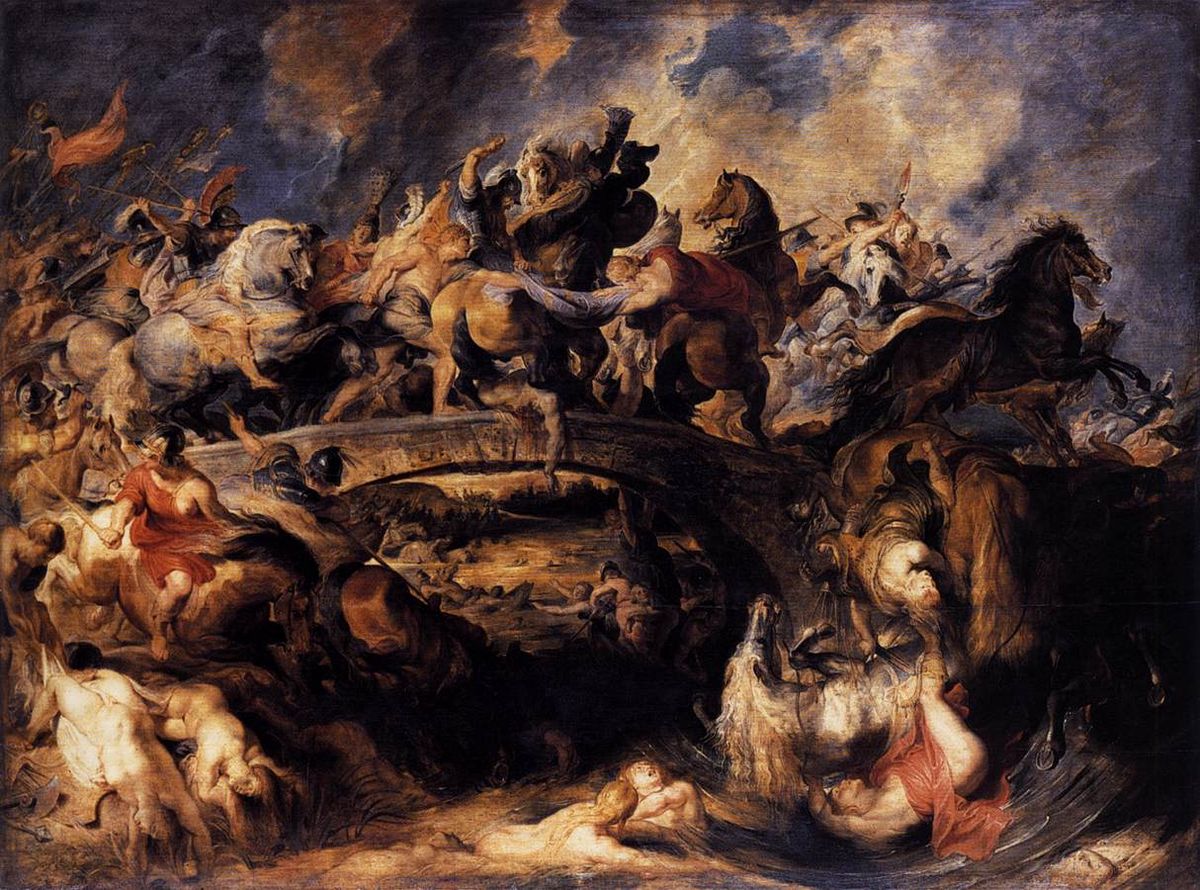
Rubens, Battle of the Amazons. At least one Amazon seems to have both breasts. (6/7/23)
Michel Onfray, L'Art d'être français. His heart's in the right place if not the felicity of his prose or indeed the cogency and consistency of his arguments. Notwithstanding, he outlines a thumbnail history of how things went so terribly wrong with the once proud French intellectual world and how grand philosophical systems like existentialism and structuralism degenerated into rhetorical tools for the Muzzy worshiping Lesbo Left (Let's call them les gouines de gauche). Along the course of his panorama he throws out interesting tidbits about Sartre and Foucault, which, if true without qualification, are certainly disturbing. It is fascinating that the French Left once nobly defended childhood sexuality before French society in general succumbed to the American shame game. It is not to Onfray's credit that he agrees with, indeed weaponizes the oppression of children, since his passage on this subject has little to do with his eventual argument against the infantilization of liberal and left wing politics. (6/12/23)
Pure dir. Lisa Langseth. I'm rather of the opinion that Mozart would have objected strongly to yet again being the icon of middlebrow aspirations to Culture. The looks of ecstasy on the actors’ faces that are supposed to tip us off to the presence of musical greatness had the unfortunate effect of recalling Peter Boyle’s soupy expression whenever Gene Wilder pulled out the old Zigeuner Geiger. Having said that, this picture is a superlative experience almost exclusively because of Vikander’s relentlessly nuanced performance as the sensitive violence prone child whose sole claim to expertise and recognition lies in her talents at oral sex. Much of the material surrounding her is fairly silly though the director Lisa Langseth and writers should be given credit for creating a complex character. It is fortunate that Vikander is on the screen through the entire length of the film since it would have fallen apart without her. This could very well be the best performance I saw in 2010 and shows why she eventually won an Oscar (for The Danish Girl).
Other associations: The off center young girl with an intense inner life that she cannot communicate to others recalls Philip Roth’s When She Was Good and much less satisfying American Pastoral. Vikander’s emotional and intelligent reading of the difficult script rights the wrongs done by Isabelle Huppert when she sleep walked through The Lacemaker. (6/13/23)
Vincenzo Bellini, Il Pirata. At Massimo in Palermo no less. Authenticity! Strange to see the chorus wearing Covid masks and the orchestra members partitioned by clear dividers. (6/24/23)
Kelly Jaye. https://spankbang.com/87g7z/video/kelly+jaye That much of porn from the seventies is disguised gay fantasy or the result of a latent homosexual sensibility is evident from this clip where the lovely Kelly Jaye is mostly reduced to a head hidden by various objects while the camera lovingly dwells on tight shots of the male talent's sweaty ecstasy and three quarters of his buff physique. (7/8/23)
Lewis Carroll. https://www.youtube.com/watch?v=H7mrIJCjTdc&list=WL&index=11 Just watched a BBC documentary where one of the commentators contended that Lewis Carroll was a severely repressed paedophile. Frankly I don't see a whole lot of repression in Carroll's life. What I do see is clever manipulation, two little girls who grew up to lead untroubled and healthy if externally rather boring bourgeois lives. I also see one of the greatest works of world literature. (7/15/23)
Possession dir. Andrzej Żuławski. "God is a disease." I can't believe I haven't seen this film before now - one of the best fuckin' horror flics around, if horror is the right word. It starts out as kind of warmed over Bergman but quickly goes completely loopy. Scraps of pretentious metaphysics and laugh out loud dialogue ("Your wife is sick. She needs help"). But Isabelle Adjani delivers her wall climbing, carpet chewing best. The one or two times I've been tempted to propose to a French girl, I was brought up short by mental images of Adjani and concluded, "Maybe not." (7/13/23)
Blonde Cobra dir. Ken Jacobs. I'm not exactly sure what this has to do with Baudelaire. (1/11/2024)
Arabian Nights dir. Miguel Gomes. Late Godard boring us in Portuguese. (2/3/24)
Desperate 2006 dir. Paul Thomas. Sometimes I forget how stunning the young Monique Alexander really was before she changed her hair. (2/3/24)
Swept Away by an Unusual Destiny in the Blue Sea of August 1974 dir. Lina Wertmüller. That must have been some pretty damn moisture resistant eye makeup 'cuz La Melato kept most of it on through months of sweat, slappings, salt water and tears. (2/3/24)
Tristan und Isolde Bayreuth 7/24/2024 cond. Semyon Bychkov. dir. Thorleifur Örn Arnarsson. stage design Vytautus Narbutas. Isolde Camilla Nylund. Tristan Andreas Schager. Curious lack of swordplay. To wit, instead of being stabbed by Melot in a garden, Tristan apparently dies by poison in a steampunk storeroom. Operatic history unfolds neatly in three epochs. The age of the composer stretched through romanticism. There followed a century of the age of conductors and singers overlapping somewhat with the age of the stage director and set designer which has dominated for the last fifty or so years. One problem is that Tristan is unstageable. It cannot be staged. It is a dream vision populated with wraith-like impossibly beautiful reflections. Perhaps an animation inspired by Moreau or Arthur Rackham.... (7/25/24)
Bertrand Bonnelo Is a sexual bulimic who force vomits quondam pleasures after his digestive apparatus has rendered them acidic and rancid. (1/22/25)
Jules et Jim 1962 and La Peau douce 1964 dir. François Truffaut. The Truffaudian ethic is manifest in watching these films back to back. If Jeanne Moreau engages in multivalent philandering, she’s mysterious, volcanic and mesmerizing. If Jean Desailly has an affair, he’s a jackass. (2/1/25)
Les Enfants terribles 1950 dir. Jean-Pierre Melville with Jean Cocteau. The titular adolescent roles, played by a poor little rich girl and Cocteau’s adopted son, looked old enough to join the cast of Friends if not quite Bob and Carol and Ted and Alice. (2/17/25)
Dancer in the Dark 2000 dir. Lars von Trier. La Traviata for sentimental and socially conscious Millennials. It displays all the weaknesses, including the risible moments, of Dumas fils. But in the same way it stays with you; it plays over and over again in your head. (3/27/25)
Die Meistersinger von Nürnberg 7/25/2025 cond. Daniele Gatti. dir. Matthias Davids. Stage directors seem to have been giving some serious thought to Wagner over the last several years and accordingly hit on the idea of actually paying attention to the text and the score rather than imposing their own fantasies and hidden meanings on the hapless performers. I was particularly enthused by the Longborough Walküre a couple of years back and its intelligent naturalistic acting, a specialty of Albion, which taught us something about the intense and nuanced relations between the characters. The values of the new Bayreuth Meistersinger are much different. The movements of the large chorus and dancers along with the many multiple character interactions were tightly choreographed with no aimless wandering around or clueless staring into space. Every gesture and expression (or nearly every; Eva’s attention seemed to wander occasionally during the finale) was planned and timed and tightly executed like the crowd scenes in some of Ophuls’ better films. More importantly Wagner always had something to say in his more tolerable music dramas. Indeed he often, as is the case in Meistersinger, tried to say several things at once. Matthias Davids took this seriously and highlighted Hans Sachs’ ruminations in a way that made us pay attention to what he was talking about, a surprising intellectual feast and not just the Bismarckian jingoism we have become accustomed to tolerating. All this kept me riveted for all five plus hours, a pleasant happenstance - especially for the often abysmally avant-garde Bayreuth - since my last Meistersinger had been some sort of all grey dismally Strindbergian rendition which made me think I had been wrong all along and Meistersinger was not Wagner’s second best opera vaguely competitive with Mozart. (It’s worth comparing the superbly written multiple character action in Act II with similarly structured scenes in Don Giovanni. Wagner’s music did not live up to the promise of his libretto. Indeed he was probably incapable of the kind of purely formal musical complexity that Mozart seemingly tossed off with one hand while playing billiards with the other.) Davids' direction and the generally rousing cast restored my confidence that Wagner could actually write comedy amid all the blood curdlingly martial parade music. Among the cast Michael Nagy was the best actor (What should we expect? He had the ham it up role) and the well-fed Michael Spyres the best singer. His forceful and lyrical delivery made Walter an actual knight, whose violent tendencies created real tension with Sachs’ firm authority, and not the preppy pussy of many interpretations. Christina Nilsson has too light a voice for Wagner and she struggled to hold the famous Quintet afloat when surrounded by the ubiquitous male voices. Still the cast at some point seemed to take things into its own hands and saved what could have been a musical mishap. I vaguely remember Solti saying somewhere that every Wagner music drama has an emotional and volumetric peak and that the expressiveness and loudness of the rest of the score needs to shade up to that peak like its slopes. Perhaps it was something along this directorial philosophy that made the Vorspiel seem a bit listless, and I was concerned I was in for a long night. But somewhere in Act II everything downshifted and the performance shot off from there. It felt like the soloists had had enough and took things into their own hands, dragging the orchestra along behind them. The weirdly eclectic stage sets and costuming did have a kind of entertainment value on their own and the bright colors of the last act are actually consistent with late mediaeval decorative taste. (7/25/25)